


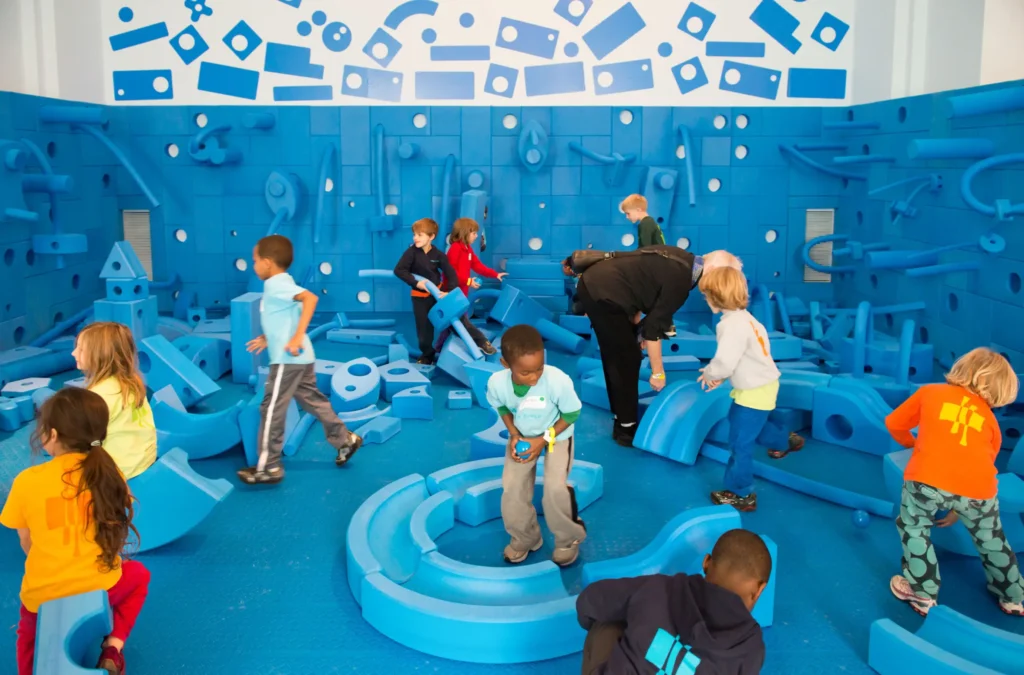
Discover how loose parts play inspires creativity, problem-solving, collaboration, and lifelong learning in children of all ages.
What Is Loose Parts Play?
Imagine walking into a play space with no instructions, no predetermined goals, and no “correct” way to play.
Instead of brightly colored plastic toys that only serve one purpose, children are surrounded by blocks, tubes, wheels, fabric, connectors, and other movable materials that can be combined, rearranged, stacked, balanced, rolled, or transformed into almost anything they can imagine.
One child builds a castle.
Another designs a spaceship.
A third creates an obstacle course.
By the end of the afternoon, those same materials have become a bustling city, a pirate ship, and a bridge connecting two imaginary islands.
This is loose parts play.
Loose parts play is a form of open-ended play in which children use movable materials to create, invent, experiment, and solve problems without predetermined outcomes. Rather than following instructions, children decide how the materials should be used, allowing creativity and curiosity to lead the experience.
The beauty of loose parts play is that there is no single “right” answer. Every child approaches the materials differently, resulting in unique ideas, discoveries, and learning opportunities.
At Imagination Playground, we’ve seen loose parts play inspire children in schools, museums, parks, libraries, hospitals, and community spaces around the world. Our Big Blue Blocks were designed with this philosophy in mind, giving children the freedom to invent, collaborate, and explore through play.
If you’re new to the concept of open-ended learning, we recommend starting with our guide, What Is Open-Ended Play? Benefits for Children’s Development, which explains why child-led play is so important for healthy development.
What Is Loose Parts Theory?
The idea behind loose parts play originated with architect Simon Nicholson, who introduced the Theory of Loose Parts in 1971.
Nicholson believed that environments rich in movable materials encourage greater creativity, curiosity, and invention than environments filled with fixed objects.
His theory proposed a simple but powerful idea:
The more variables an environment contains, the more opportunities children have to discover, create, and learn.
Rather than providing children with finished products that dictate how they should be used, Nicholson advocated for environments filled with materials that children could manipulate freely.
Those “loose parts” might include:
- Oversized blocks
- Wooden planks
- Tubes
- Wheels
- Fabric
- Crates
- Stones
- Rope
- Buckets
- Sand
- Water
- Natural materials
Each object can serve countless purposes depending on a child’s imagination.
More than 50 years later, Nicholson’s theory continues to influence educators, playground designers, museums, and child development experts around the world.
What Counts as a Loose Part?
Loose parts can be almost anything that can be moved, combined, redesigned, stacked, balanced, or incorporated into imaginative play.
They generally fall into three categories.
Natural Loose Parts
Nature provides an endless supply of creative materials.
Examples include:
- Sticks
- Pinecones
- Logs
- Rocks
- Leaves
- Shells
- Sand
- Water
- Seed pods
- Tree cookies
- Flowers
- Bark
Outdoor classrooms often use these materials because they encourage exploration while helping children connect with nature.
Recycled Loose Parts
Many loose parts are inexpensive or even free.
Examples include:
- Cardboard boxes
- PVC pipe
- Bottle caps
- Fabric scraps
- Plastic containers
- Milk crates
- Wooden pallets
- Paper tubes
- Pool noodles
- Egg cartons
These materials allow children to see everyday objects in entirely new ways.
Manufactured Loose Parts
Purposefully designed loose parts provide durability, safety, and versatility.
Examples include:
- Large foam blocks
- Building planks
- Foam wheels
- Construction connectors
- Play panels
- Large gears
- Fabric panels
- Flexible tubes
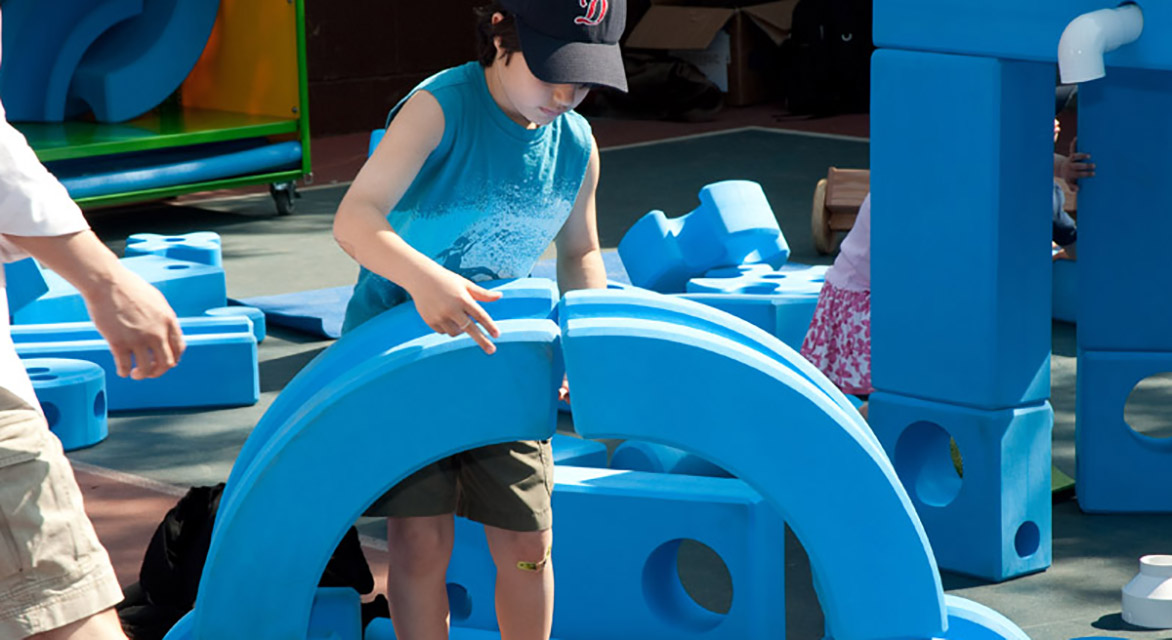
Imagination Playground’s Big Blue Blocks are an excellent example. Their unique shapes encourage children to build structures that would be difficult—or impossible—with traditional square blocks, inspiring experimentation, collaboration, and imaginative storytelling.
Why Is Loose Parts Play Important?
Children learn best when they are active participants in the learning process.
Loose parts play gives children ownership over their ideas instead of asking them to follow directions.
When children decide:
- what to build,
- how to build it,
- who to build with,
- and how to solve challenges,
they become designers, engineers, storytellers, scientists, artists, and leaders all at once.
Every decision requires observation, experimentation, and adaptation.
A tower falls.
Children redesign it.
A bridge won’t balance.
They test another solution.
A group can’t agree.
They negotiate.
These are not isolated skills.
They are the building blocks of lifelong learning.
One preschool teacher experienced this firsthand after introducing Imagination Playground Blue Blocks into the classroom. By providing engaging materials and stepping back, the children naturally developed stronger collaboration, creativity, and problem-solving skills. Read the inspiring story in Stepping Back and Watching Big Ideas Take Shape.
Loose Parts Play vs. Traditional Toys
Traditional toys often have a single intended purpose.
A toy kitchen is used as a kitchen.
A toy fire truck is used as a fire truck.
A puzzle has one correct solution.
Loose parts are different.
One foam arch may become:
- a tunnel,
- a rainbow,
- a dinosaur tail,
- a bridge,
- a race car,
- or the entrance to a castle.
Tomorrow, that same piece will likely become something entirely different.
Because the materials never lose their possibilities, children’s interest doesn’t fade after a few uses. Every play session presents a new challenge, a new story, and a new opportunity to create.
This flexibility is one of the reasons educators, museums, and community organizations continue to embrace loose parts play as a powerful learning tool.
The Developmental Benefits of Loose Parts Play
Loose parts play is much more than a fun activity—it supports nearly every area of child development simultaneously. Because children direct their own play, they naturally combine creativity, movement, communication, critical thinking, and social interaction in ways that traditional activities often cannot replicate.
Whether children are building with oversized foam blocks, arranging natural materials, or inventing elaborate pretend worlds, they are developing essential life skills that extend well beyond the playground.
Let’s explore some of the most significant benefits.
1. Encourages Creativity and Imagination
One of the greatest strengths of loose parts play is its ability to nurture creativity.
Unlike toys with a single purpose, loose parts invite endless possibilities.
A curved block can become:
- A bridge
- A dragon’s tail
- A rocket booster
- A tunnel
- A wave
- A race track
- A sculpture
Children aren’t told what the object represents—they decide.
Every decision becomes an act of creative thinking.
Instead of asking, “What is this supposed to be?” children begin asking:
- “What could this become?”
- “What happens if I add another piece?”
- “Can we make it bigger?”
- “What story are we telling?”
These questions help children develop flexible thinking—an increasingly valuable skill in school, future careers, and everyday life.
Because there are no wrong answers, children also become more willing to take creative risks, test new ideas, and embrace experimentation.
2. Builds Critical Thinking and Problem-Solving Skills
Every construction project presents challenges.
A tower begins to lean.
A bridge won’t span the gap.
A structure keeps collapsing.
Rather than asking an adult for the answer, children begin testing solutions.
They might:
- Change the foundation.
- Redistribute the weight.
- Use different shapes.
- Work together to stabilize the structure.
- Completely redesign their plan.
This process mirrors the engineering design cycle:
- Identify the problem.
- Brainstorm ideas.
- Test a solution.
- Evaluate the results.
- Improve the design.
Children experience this naturally through play.
There are no worksheets.
No lectures.
Just discovery.
3. Supports STEM Learning
Loose parts play is one of the most natural introductions to STEM (Science, Technology, Engineering, and Mathematics).
As children build, experiment, and redesign, they explore concepts including:
Science
Children investigate:
- Gravity
- Balance
- Motion
- Friction
- Stability
- Cause and effect
Technology
Technology isn’t limited to computers.
Children use simple tools and materials to solve problems and improve designs.
Engineering
Engineering becomes tangible as children:
- Design structures
- Test ideas
- Modify plans
- Strengthen weak points
- Build larger and more complex creations
Mathematics
Without realizing it, children practice:
- Counting
- Comparing sizes
- Measuring
- Patterns
- Symmetry
- Geometry
- Estimation
- Spatial reasoning
These concepts become meaningful because children experience them firsthand.
4. Develops Executive Function Skills
Executive function refers to the mental skills that help children:
- Focus attention
- Plan ahead
- Organize information
- Control impulses
- Adapt to changing situations
- Remember instructions
Loose parts play exercises all of these abilities.
Imagine several children building a city.
They must:
- Remember their plan.
- Organize materials.
- Decide what to build first.
- Wait for turns.
- Solve disagreements.
- Adjust when something doesn’t work.
These are executive function skills in action.
Many educators consider executive function one of the strongest predictors of future academic success.
5. Strengthens Social Skills
Large loose parts naturally encourage collaboration.
Many creations simply can’t be built by one child alone.
As children work together, they learn how to:
- Listen to ideas
- Explain their thinking
- Compromise
- Share responsibilities
- Encourage teammates
- Solve conflicts respectfully
Sometimes children assign roles:
- Architect
- Builder
- Designer
- Decorator
- Storyteller
These interactions help develop communication skills while teaching children how to work toward shared goals.
At Imagination Playground installations around the world, it’s common to see children who have never met before working together within minutes of arriving.
6. Builds Confidence
Loose parts play celebrates experimentation rather than perfection.
There isn’t one correct answer.
There isn’t a score.
There isn’t a finished example to copy.
Instead, children experience success by:
- Trying something new.
- Improving an idea.
- Solving a challenge.
- Working together.
- Completing a project.
Even failures become valuable learning experiences.
When a structure falls, children rarely quit.
Instead they ask:
“What can we change?”
That mindset builds resilience.
A wonderful example comes from our blog post Stepping Back and Watching Big Ideas Take Shape, where children developed remarkable confidence simply because adults allowed them to lead the learning process.
7. Promotes Social-Emotional Learning
Loose parts play creates opportunities to practice important emotional skills.
Children experience:
- Patience
- Empathy
- Cooperation
- Leadership
- Negotiation
- Self-regulation
Pretend play also allows children to process emotions in a safe environment.
One group might build a hospital.
Another creates a neighborhood.
Another imagines a rescue mission.
These stories often reflect children’s experiences while helping them better understand themselves and others.
During challenging times, creative play can also strengthen communities by bringing children and families together through shared experiences. Learn more in How Open-Ended Play Helps Our Community Heal.
8. Encourages Physical Development
Loose parts play isn’t just mentally engaging—it keeps children moving.
Large building materials require children to:
- Lift
- Carry
- Push
- Pull
- Reach
- Balance
- Crawl
- Stretch
These movements strengthen:
- Gross motor skills
- Coordination
- Core strength
- Balance
- Spatial awareness
Meanwhile, arranging smaller loose parts develops:
- Fine motor control
- Hand-eye coordination
- Finger strength
- Dexterity
Unlike sedentary activities, loose parts play combines movement with imagination.
9. Inspires Communication and Language Development
Every collaborative project involves conversation.
Children naturally discuss:
- Plans
- Ideas
- Rules
- Stories
- Problems
- Solutions
Vocabulary expands as they describe:
- Shapes
- Sizes
- Positions
- Materials
- Emotions
- Roles
Educators often observe children using increasingly sophisticated language while engaged in imaginative construction projects because they are motivated to communicate.
10. Supports Inclusive Play
One of the greatest advantages of loose parts is their flexibility.
Children participate in different ways based on:
- Age
- Interests
- Abilities
- Experience
- Confidence
Some children build.
Some tell stories.
Some organize materials.
Some become leaders.
Others quietly observe before joining.
Because there isn’t a single correct way to play, children can contribute according to their strengths.
This inclusive nature makes loose parts play especially valuable in schools, museums, parks, libraries, and community spaces serving children with diverse needs.
How Loose Parts Play Benefits Different Age Groups
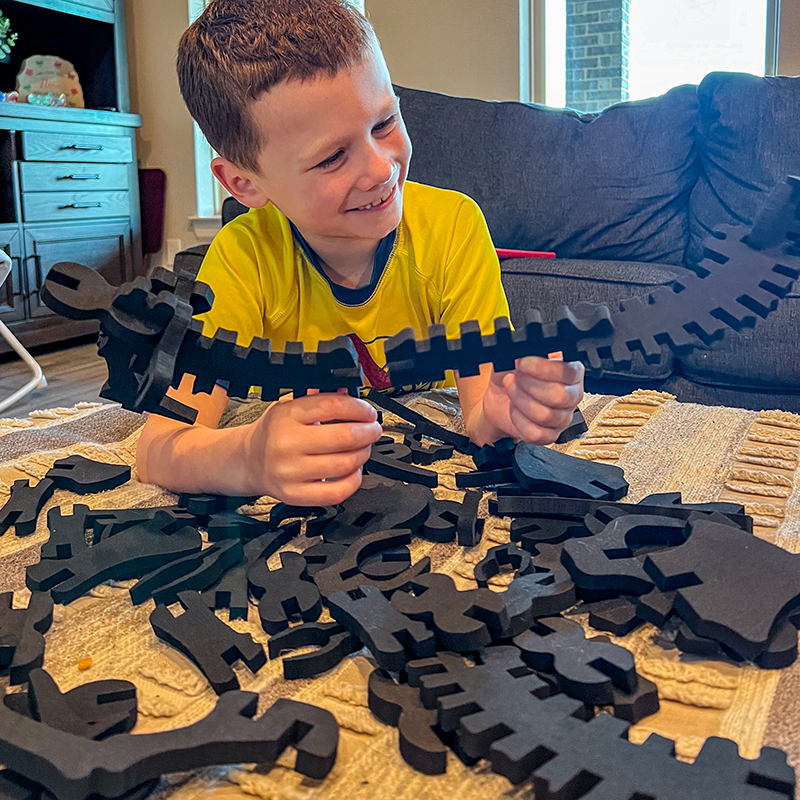
One remarkable characteristic of loose parts play is that it grows alongside the child.
Toddlers
Young children explore by:
- Carrying
- Stacking
- Rolling
- Sorting
- Filling
- Dumping
These simple actions develop coordination while encouraging curiosity.
Preschoolers
Preschool-aged children begin:
- Building imaginative structures
- Pretend play
- Collaborative projects
- Storytelling
- Early engineering
This stage is where creativity flourishes.
Elementary Students
Older children create increasingly sophisticated designs involving:
- Bridges
- Cities
- Vehicles
- Mazes
- Obstacle courses
- Team challenges
Projects often require planning, measurement, negotiation, and redesign.
Middle School and Beyond
Even older students remain engaged.
Loose parts become tools for:
- Design thinking
- Engineering challenges
- Architecture
- Physics demonstrations
- Community design projects
- Collaborative problem-solving
The materials don’t become less valuable—they simply support more advanced thinking.
Why Educators Love Loose Parts Play
Teachers often discover that loose parts naturally integrate multiple learning standards without requiring separate lessons.
One activity may simultaneously support:
- STEM
- Literacy
- Social-emotional learning
- Physical education
- Art
- Collaboration
- Critical thinking
Instead of teaching each skill independently, children develop them together through meaningful experiences.
This is one reason loose parts play continues to gain popularity in classrooms around the world.
Creating Inspiring Loose Parts Play Environments
One of the greatest advantages of loose parts play is that it doesn’t require an elaborate playground or expensive equipment to get started. What matters most is providing children with a variety of open-ended materials and the freedom to explore them.
Whether you’re designing a classroom learning center, a museum exhibit, a public park, or a community play event, the goal is the same: create an environment that encourages curiosity, creativity, collaboration, and experimentation.
The best loose parts environments invite children to ask one simple question:
“What can I create today?”
Choosing the Right Loose Parts
A successful loose parts collection includes a variety of materials with different shapes, sizes, textures, and functions.
Try to include items that children can:
- Stack
- Balance
- Roll
- Connect
- Carry
- Arrange
- Build with
- Pretend with
The more possibilities each material offers, the richer the play experience becomes.
Natural Materials
Natural loose parts connect children with the outdoors while encouraging observation and sensory exploration.
Examples include:
- Logs
- Tree cookies
- Pinecones
- Smooth stones
- Sticks
- Shells
- Leaves
- Sand
- Water
- Bamboo
These materials are especially popular in outdoor classrooms and nature-based learning environments.
Recycled Materials
Many outstanding loose parts can be collected at little or no cost.
Examples include:
- Cardboard tubes
- Milk crates
- Plastic buckets
- PVC pipe
- Fabric remnants
- Rope
- Wooden pallets
- Egg cartons
- Large spools
- Plastic lids
These materials encourage children to see everyday objects in completely new ways.
Purpose-Built Loose Parts
Purpose-built loose parts offer durability, versatility, and safety while encouraging even larger collaborative projects.
Examples include:
- Oversized foam blocks
- Foam wheels
- Large connectors
- Building planks
- Play panels
- Flexible tubes
- Construction arches
Purpose-built systems are especially valuable in schools, museums, libraries, children’s hospitals, parks, and community events where hundreds of children may use the materials throughout the day.
Why Imagination Playground Is a Perfect Example of Loose Parts Play
Imagination Playground was created around the principles of loose parts theory long before the phrase became widely recognized.
Every Big Blue Block was intentionally designed without a predetermined purpose.
A curved piece isn’t labeled as a tunnel.
A cylinder isn’t labeled as a wheel.
A wedge isn’t labeled as a ramp.
Instead, children decide.
One day a piece becomes:
- A dragon’s neck
The next day it becomes:
- A bridge
Later it transforms into:
- A telescope
- A race car
- A submarine
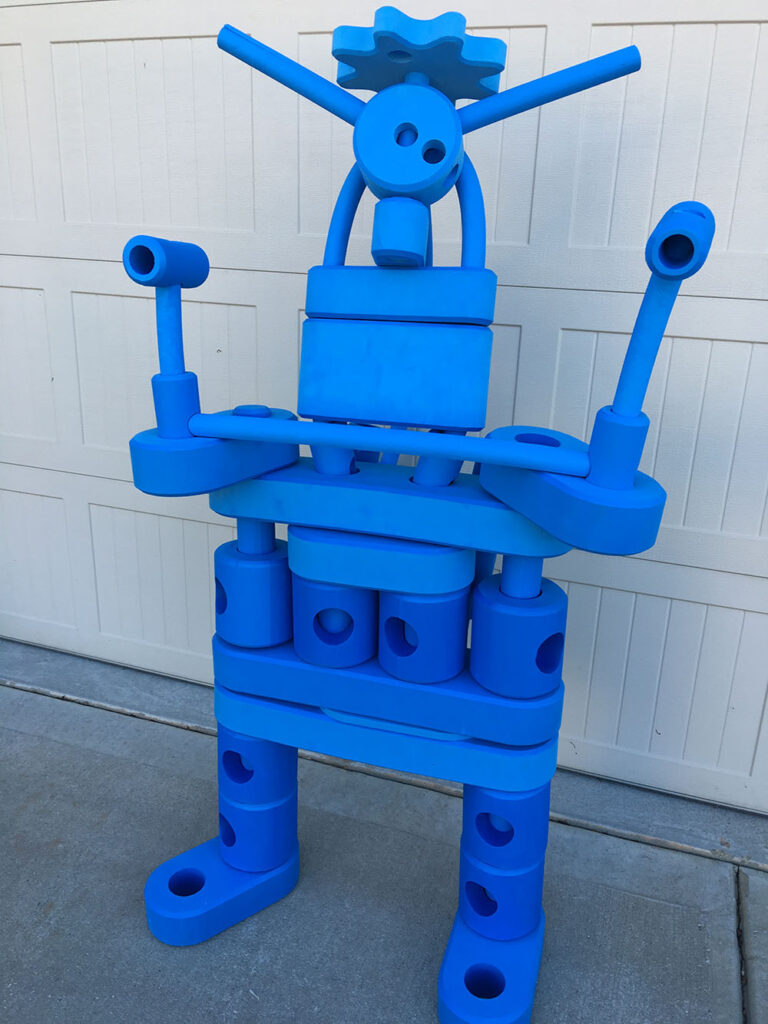
- A robot arm
- A castle wall
There are no instructions because the child is the designer.
That’s exactly what Simon Nicholson envisioned when he introduced Loose Parts Theory more than 50 years ago.
If you’d like to explore the full collection, visit our Big Blue Blocks page to see how schools, museums, parks, and communities are using open-ended building materials to inspire creative play.
Loose Parts Play in Schools
Schools are among the most effective environments for loose parts play because the same materials can support dozens of learning objectives.
Teachers often integrate loose parts into:
- STEM lessons
- Literacy activities
- Social studies
- Art
- Physical education
- Recess
- Indoor learning centers
- Outdoor classrooms
For example, a single building challenge might ask students to design a bridge that spans six feet.
Children naturally begin discussing:
- Stability
- Measurement
- Balance
- Weight distribution
- Teamwork
- Engineering
Without realizing it, they’re practicing science, mathematics, communication, and collaboration simultaneously.
Loose Parts Play in Museums
Children’s museums have embraced loose parts play because every visit becomes a new experience.
Instead of static exhibits, museums can offer environments where children actively shape their own learning.
One family may build an entire city.
Another designs an underwater world.
A third invents a transportation system.
No two visits are alike.
This keeps exhibits fresh while encouraging repeat visits.
A great example is the Explorium Denton Children’s Museum, where Imagination Playground helps create interactive experiences that encourage creativity, collaboration, and discovery.
Loose Parts Play in Libraries
Libraries have evolved into vibrant community learning spaces.
Many now host:
- Family play days
- STEM workshops
- Story-based building challenges
- Summer learning programs
- Creative maker activities
Loose parts complement these programs perfectly because they encourage children to extend stories through imaginative play.
After reading a book, children might:
- Build the setting.
- Create a new ending.
- Design vehicles for the characters.
- Construct an entire imaginary world.
The result is deeper engagement with literacy through hands-on creativity.
Loose Parts Play in Parks
Traditional playgrounds often guide children toward specific activities.
Slides are for sliding.
Swings are for swinging.
Climbing structures have predetermined paths.
Loose parts create something entirely different.
Children design the playground experience themselves.
One afternoon they build:
- Castles
The next:
- Obstacle courses
Later:
- Giant sculptures
Community festivals often include temporary loose parts play installations because they invite families to play together while encouraging creativity across multiple age groups.
One wonderful example is the installation at the Westchase District in Houston, Texas, where Imagination Playground transformed a public space into a destination for collaborative play.
Loose Parts Play in Community Spaces
Community organizations increasingly recognize that play brings people together.
Loose parts installations have appeared in:
- Community centers
- Hospitals
- Festivals
- Farmers markets
- Cultural events
- Neighborhood celebrations
- Recreation centers
Unlike many activities that separate children by age, loose parts naturally encourage intergenerational play.
Parents begin building.
Grandparents join in.
Teenagers help younger children.
Entire families collaborate on projects they never could have planned ahead of time.
This shared creativity strengthens community connections.
Our article How Open-Ended Play Helps Our Community Heal highlights the powerful role that creative play can have in bringing people together during challenging times.
Loose Parts Play Around the World
One of the most inspiring aspects of Imagination Playground is seeing how children from different cultures use the exact same materials in completely different ways.
Around the globe, communities have transformed Big Blue Blocks into opportunities for learning, creativity, and collaboration.
Explore a few examples:
- MakeBelieve – The Baby Play Place in Edinburgh, Scotland demonstrates how open-ended play supports imaginative exploration for young children.
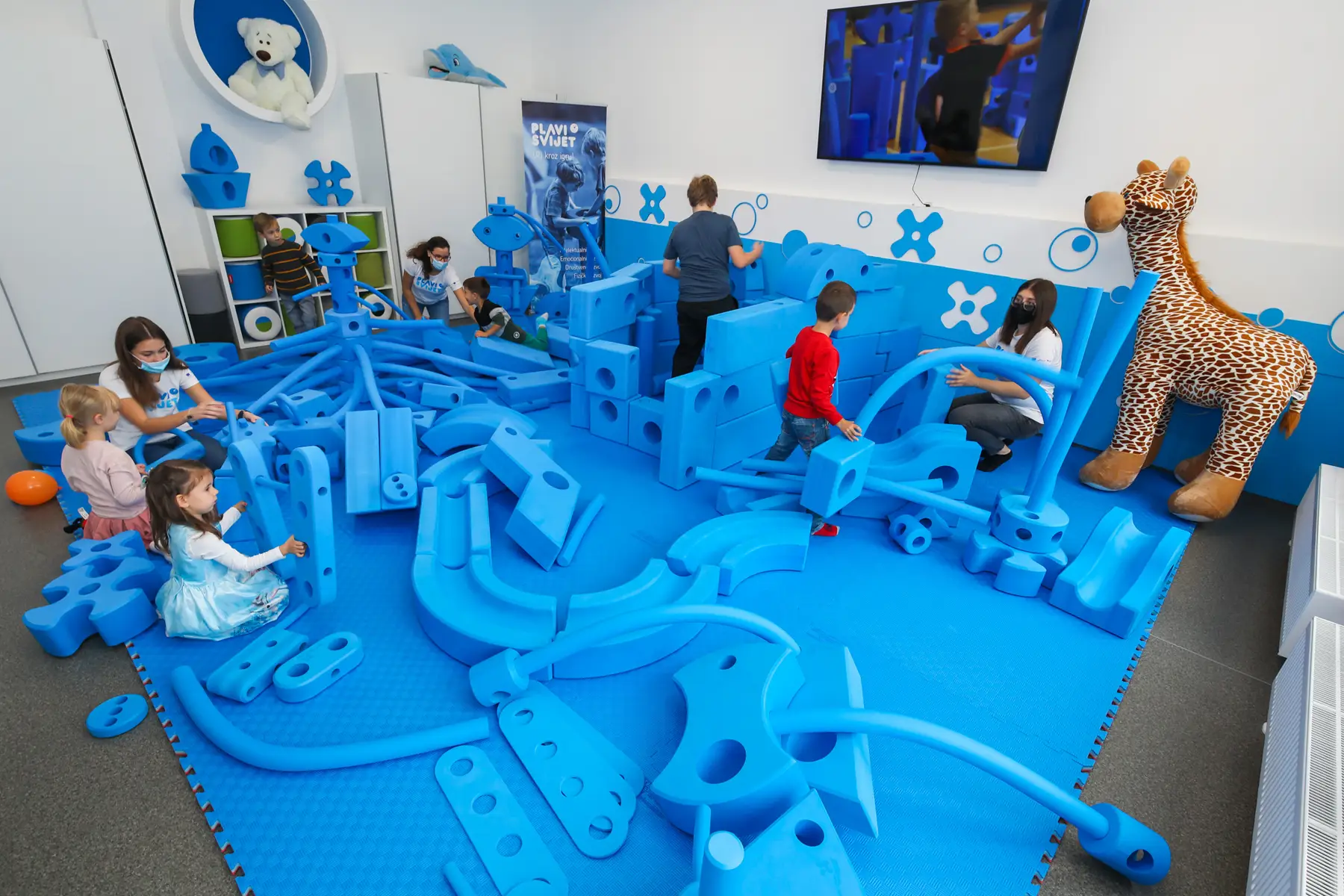
- Blue World (Plavi Svijet) in Croatia showcases creative community engagement through play.
- Visit our Where in the World Are the Blue Blocks? series to discover installations in schools, museums, parks, libraries, and public spaces across the globe.
Although every community is different, one thing remains remarkably consistent:
Give children loose parts…
…and they will surprise you.
Best Practices for Facilitating Loose Parts Play
Adults play an important role during loose parts play—but it’s often a quieter role than many expect.
Instead of directing the activity, think of yourself as a facilitator.
Provide Variety
Offer materials with different:
- Sizes
- Shapes
- Weights
- Textures
- Colors
- Functions
New combinations inspire new ideas.
Resist the Urge to Demonstrate
Children don’t need to be shown what to build.
If adults immediately demonstrate the “right” way to use the materials, children often imitate rather than innovate.
Instead, allow children to make discoveries independently.
Ask Open-Ended Questions
Rather than giving answers, encourage thinking.
Try questions like:
- What do you notice?
- How could you make it stronger?
- What else could this become?
- Can you build it differently?
- What story does your creation tell?
These conversations extend learning without taking ownership away from the child.
Celebrate the Process
The goal isn’t building the tallest tower.
The goal is exploring ideas.
Praise creativity, persistence, teamwork, and experimentation—not just finished structures.
Children who feel safe taking creative risks become more confident learners.
Safety Considerations
Loose parts play should always be supervised using age-appropriate materials.
When selecting loose parts:
- Inspect materials regularly.
- Remove damaged pieces.
- Consider choking hazards for young children.
- Provide enough space for movement.
- Encourage respectful collaboration.
- Match materials to children’s developmental abilities.
Purpose-built systems like Imagination Playground’s foam blocks are designed for repeated use in schools, museums, parks, and community settings while supporting safe, active play.
Looking Ahead
By now, it’s clear that loose parts play is much more than a collection of movable objects. It’s a philosophy that empowers children to lead their own learning, collaborate with others, and discover new possibilities every time they play.
In the final section, we’ll answer common questions about loose parts play, discuss how parents and educators can get started, and summarize why this approach continues to inspire children—and communities—around the world.
Frequently Asked Questions About Loose Parts Play
What is loose parts play?
Loose parts play is a form of open-ended play that allows children to use movable materials in creative and imaginative ways. Rather than following instructions or working toward a predetermined outcome, children decide how the materials will be used, encouraging creativity, collaboration, and problem-solving.
Examples of loose parts include natural materials like sticks and stones, recycled items such as cardboard tubes and crates, and purpose-built materials like Imagination Playground Big Blue Blocks.
What is the difference between loose parts play and open-ended play?
These terms are closely related, but they’re not exactly the same.
Open-ended play refers to any play experience without a predetermined outcome.
Loose parts play is one type of open-ended play that specifically uses movable materials children can manipulate, combine, redesign, and transform.
In other words, all loose parts play is open-ended play, but not all open-ended play involves loose parts.
Why is loose parts play important?
Loose parts play supports multiple areas of child development at the same time.
Children naturally practice:
- Creativity
- Critical thinking
- Communication
- Collaboration
- Engineering
- Problem-solving
- Executive function
- Social-emotional learning
- Gross and fine motor development
Because children are directing their own learning, these skills develop through meaningful experiences rather than memorization.
What are examples of loose parts?
Loose parts can be almost anything children can move and use creatively.
Examples include:
Natural materials
- Rocks
- Logs
- Pinecones
- Shells
- Sand
- Water
Recycled materials
- Cardboard boxes
- PVC pipe
- Fabric
- Milk crates
- Buckets
- Paper tubes
Purpose-built materials
- Oversized foam blocks
- Wheels
- Building panels
- Connectors
- Construction planks
The more flexible the material, the more opportunities children have to imagine new possibilities.
At what age can children begin loose parts play?
Loose parts play can begin during infancy using safe, age-appropriate materials.
As children grow, the complexity of their play naturally evolves.
Toddlers may:
- Carry
- Stack
- Sort
- Fill containers
Preschoolers begin imaginative construction and storytelling.
Elementary-aged children often design elaborate engineering projects and collaborative structures.
Even teenagers and adults enjoy loose parts during design challenges, maker activities, and community events.
Is loose parts play good for classrooms?
Absolutely.
Teachers often use loose parts to support:
- STEM education
- Literacy
- Social-emotional learning
- Cooperative learning
- Outdoor education
- Physical activity
- Art
- Design thinking
Because one activity can address multiple learning standards, loose parts are an excellent addition to nearly every educational environment.
Can loose parts play happen indoors?
Yes.
Many classrooms, libraries, museums, recreation centers, and children’s hospitals use loose parts indoors.
Purpose-built materials such as Imagination Playground Big Blue Blocks are lightweight, durable, and designed for both indoor and outdoor learning environments.
Does loose parts play encourage teamwork?
One of the greatest strengths of loose parts play is collaboration.
Large construction projects naturally encourage children to:
- Share ideas
- Solve problems together
- Divide responsibilities
- Communicate
- Negotiate
- Encourage one another
Children often build friendships while building structures.
How do adults support loose parts play?
Adults don’t need to direct the play.
Instead, they can:
- Provide interesting materials.
- Ask thoughtful questions.
- Encourage exploration.
- Ensure safety.
- Observe learning.
- Celebrate creativity.
Often, the most powerful thing an adult can do is simply give children the time and space to explore independently.
As one preschool teacher discovered, stepping back often allows children to accomplish far more than adults expect. Read Stepping Back and Watching Big Ideas Take Shape to see this philosophy in action.
Why Imagination Playground Continues to Inspire Creative Play
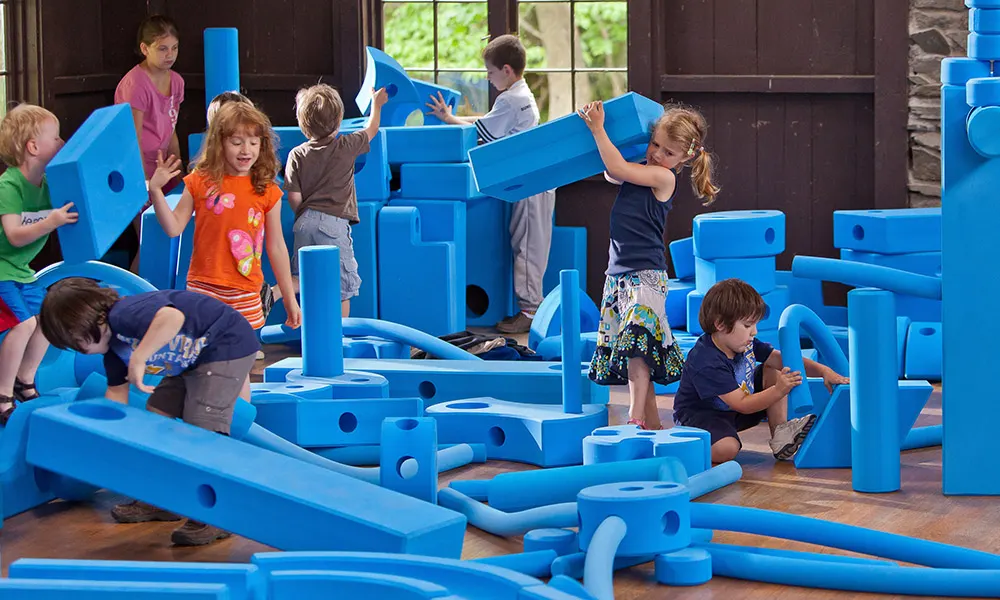
Every day, children around the world use Imagination Playground Big Blue Blocks to create experiences that no adult could have planned.
A bridge becomes a castle.
A castle becomes a spaceship.
The spaceship transforms into a dragon.
The dragon becomes an entire city.
Each idea builds upon the last because children are free to imagine without limits.
This flexibility makes Imagination Playground an ideal resource for:
- Schools
- Early childhood programs
- Museums
- Libraries
- Parks
- Community centers
- Recreation departments
- Children’s hospitals
- Festivals
- Family events
Whether children are working independently or collaborating with dozens of friends, every play session becomes an opportunity to learn through exploration.
See how organizations around the world are creating unforgettable play experiences in our Where in the World Are the Blue Blocks? series.
Final Thoughts
Loose parts play reminds us of something children have always known:
The best play doesn’t come from following instructions.
It comes from curiosity.
When children are given materials they can move, combine, redesign, and transform, they don’t just build towers or castles—they build confidence, resilience, communication skills, creativity, and lifelong problem-solving abilities.
Whether the setting is a classroom, museum, library, park, or community event, loose parts create opportunities for meaningful learning through joyful exploration.
At Imagination Playground, we’ve watched children across the globe use the same collection of Big Blue Blocks to create completely different worlds. Every structure tells a story. Every collaboration teaches a lesson. Every new idea begins with a simple question:
“What can we build today?”
If you’re looking to create inspiring environments where imagination leads the way, explore our Big Blue Blocks and discover how open-ended, loose parts play is helping children learn, collaborate, and thrive around the world.
Continue Exploring
Interested in learning more about play-based learning and creative environments? Explore these related articles: