



Twenty-two years ago, researchers were already documenting a decline in outdoor play. Since then, childhood has changed dramatically—but children haven’t.
They still want to move, explore, imagine, build, create, and play.
What has changed is the world surrounding them.
In 2004, Hofstra University professor Rhonda Clements published a study with a simple but important question:
Were children still playing outside the way their parents had?
For An Investigation of the Status of Outdoor Play, Clements surveyed 830 mothers across the United States, asking them to compare their own childhood play experiences with those of their children.
The results painted a picture of a childhood already beginning to change.
Children were spending considerably less time playing outdoors than their mothers had. Their activities were changing. More time was being spent indoors and in controlled environments. Television and electronic entertainment were competing with outdoor play. And opportunities for the imaginative, child-created games that once filled backyards, neighborhoods, playgrounds, and empty patches of grass were becoming less common.
That was 2004.
There were no iPads.
There was no TikTok.
YouTube hadn’t launched.
The first iPhone was still three years away.
Yet researchers were already asking what was happening to outdoor play.
Twenty-two years later, that question feels more important than ever.
What Clements Saw in 2004
Five themes stand out from Clements’ research:
- Children were playing outdoors less than previous generations.
- The nature of outdoor play was changing, with fewer imaginative and child-created games.
- Children were spending more time indoors and in controlled environments.
- Television and electronic entertainment were competing with time for outdoor play.
- Parents recognized how important outdoor play was for children’s physical, social, creative, and cognitive development.
More than two decades later, these observations sound remarkably familiar.
But the world surrounding childhood has changed dramatically.

The Screen Didn’t Stay in the Living Room
In 2004, concern about technology largely centered around television, video games, and computers.
Today, screens travel with children.
They are in our homes, cars, restaurants, waiting rooms—and increasingly, classrooms. Tablets, smartphones, streaming platforms, gaming systems, social media, educational apps, and endless on-demand content have made digital experiences available almost everywhere.
Technology itself isn’t the enemy. It can educate, connect, entertain, and provide children with experiences previous generations could never have imagined.
But childhood still has only so many hours in a day.
And every hour spent consuming an experience is an hour that can’t also be spent creating one.
Recent research has continued to examine that balance.
A 2023 study published in JAMA Pediatrics followed young children to examine the relationship between screen time, outdoor play, and later development. Researchers found that higher screen exposure at age two was associated with poorer outcomes in some developmental areas at age four. Importantly, frequent outdoor play appeared to mitigate part of the association involving daily living skills, and outdoor play was positively associated with socialization.
The researchers concluded that outdoor play may offer an important opportunity for intervention when considering children’s increasingly screen-filled lives.
The answer isn’t simply fewer screens. Children also need somewhere meaningful to go when the screens turn off.
We Haven’t Just Changed How Much Children Play. We’ve Changed How They Play.
One of Clements’ most important observations wasn’t simply that children were spending less time outside.
Their play itself was changing.
Free play asks something very different of a child than passive entertainment or an activity designed entirely by an adult.
When children are given open-ended materials and enough freedom to use them, they have to decide:
What should we make?
How will this work?
Who is going to do what?
What happens if it falls?
Can we try it another way?
Those questions require creativity, communication, negotiation, problem-solving, movement, experimentation, and persistence.
And modern research continues to point toward the importance of environments that make this kind of play possible.
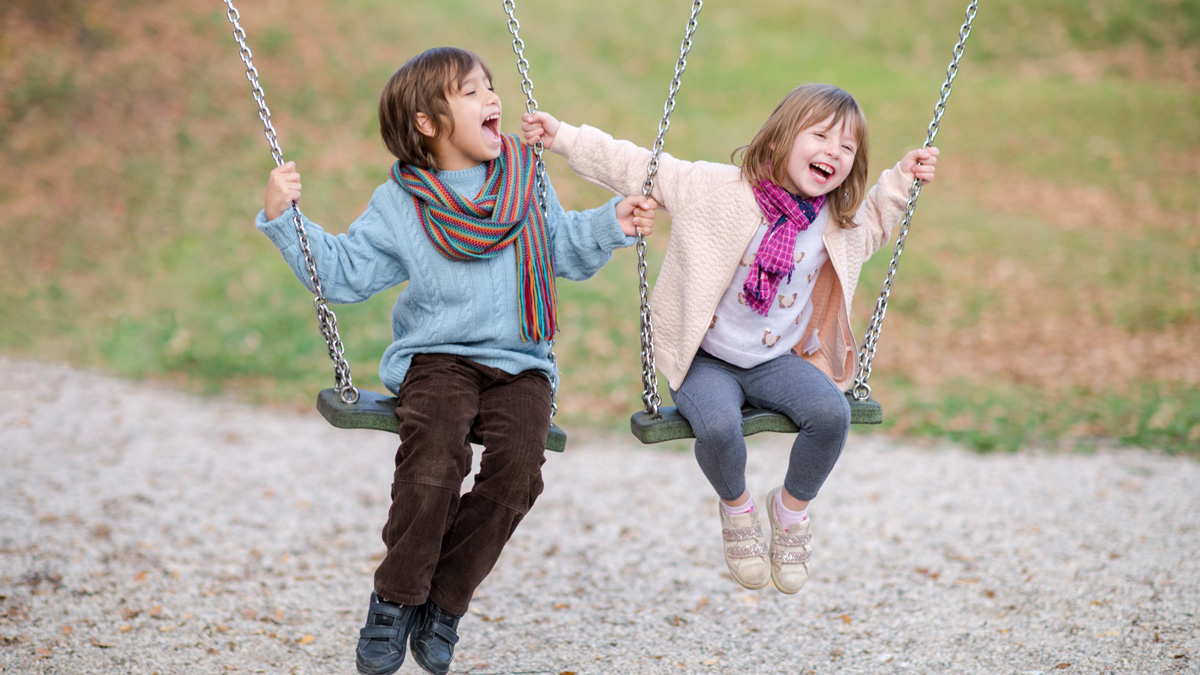
A 2024 systematic review published in Health & Place examined outdoor play environments for children ages 5–12. Researchers specifically considered features including equipment, natural elements, terrain, available resources, and loose parts—materials children can move, manipulate, combine, redesign, and use in different ways during play.
The researchers began with a concern that echoes Clements’ work twenty years earlier:
Children’s opportunities to play outdoors have declined.
That means the question today isn’t simply whether we provide children with a playground.
We also need to ask:
What kind of play does that environment invite?
Even Our Desire to Protect Children Can Limit Their Play
Screens aren’t the only thing that changed.
Childhood itself has become increasingly supervised and structured.
Adults naturally want children to be safe. But in trying to eliminate every possible bump, fall, disagreement, uncertainty, or risk, we can unintentionally remove some of the experiences through which children learn.
In 2024, the Canadian Pediatric Society issued a position statement addressing the decline in outdoor free play and what researchers call “risky play.”
Their recommendation offers an important distinction:
Children should be kept “as safe as necessary,” rather than “as safe as possible.”
Appropriate challenge allows children to test their abilities, assess situations, make decisions, build confidence, and gradually understand their own limits.
A child climbing, balancing, building something taller than themselves, moving a heavy object with a friend, or figuring out why their creation keeps falling isn’t doing “nothing.”
They’re learning.
Twenty Years of Playground Research Points in the Same Direction
Another major 2024 review looked at research on playgrounds and children’s health published between 2000 and 2023.
Researchers identified 247 publications examining playgrounds in schoolyards, early-childhood settings, public spaces, and other environments.
The research included outcomes involving physical activity, social health, mental health, motor skills, and more.
In other words, the case for play isn’t based on nostalgia.
We don’t need children to play simply because that’s what we did when we were kids.
Children need opportunities to play because play is part of how children develop.
And that brings us back to perhaps the most hopeful finding from Clements’ original study.
Finding #5 May Be the One That Matters Most
In 2004, Clements found that mothers recognized the need for outdoor play.
They understood its importance for physical and motor development, social skills, creativity, and cognitive growth.
Twenty-two years later, parents and educators still recognize it.
The challenge is turning that recognition into opportunity.
Because knowing children need to play isn’t the same thing as protecting time for it.
We have to create environments where children are allowed to move.
We have to protect recess and free-play opportunities.
We have to give children materials that don’t dictate exactly what they’re supposed to create.
We have to become comfortable with a little mess, noise, experimentation, disagreement, rebuilding, and uncertainty.
And sometimes, we simply have to turn the screen off and give children enough time to figure out what happens next.
At first, they may tell us:
“I’m bored.”
Maybe that’s okay.
Because boredom can become a fort.
A cardboard box can become a spaceship.
A pile of loose parts can become a castle, obstacle course, restaurant, robot, race car—or something an adult would never have thought to build.
And an empty patch of playground can become an entire world.

Maybe Children Haven’t Changed as Much as Childhood Has
Children still want to move.
They still want to explore.
They still want to build things, knock them down, make up games, tell stories, take chances, negotiate with friends, get dirty, laugh loudly, and proudly announce:
“Look what we made!”
Twenty-two years after Clements documented the decline of outdoor play, perhaps the most important question isn’t whether children have lost the ability to play.
It’s whether we’ve given them enough time, space, freedom, and opportunity to do it.
The research continues to remind us of something children have always seemed to know:
Play isn’t time away from learning.
Play is part of how childhood learns.
And if parents and educators recognize its importance—as they did in 2004 and still do today—then we have an opportunity to change the trajectory.
One playground.
One classroom.
One neighborhood.
One block at a time.
Continue Exploring the Research
Rhonda Clements (2004) An Investigation of the Status of Outdoor Play — Contemporary Issues in Early Childhood Clements surveyed 830 mothers across the United States and documented generational differences in children’s outdoor play.
Pereira et al. (2024) Associations between outdoor play features and children’s behavior and health: A systematic review — Health & Place A systematic review examining outdoor play environments, including equipment, natural elements, terrain, resources, and loose parts.
Schipperijn et al. (2024) The role of playgrounds in promoting children’s health – a scoping review — International Journal of Behavioral Nutrition and Physical Activity A review encompassing 247 publications investigating playground use and physical, mental, and social health outcomes.
Canadian Paediatric Society (2024) Healthy childhood development through outdoor risky play: Navigating the balance with injury prevention A position statement addressing the importance of free outdoor play, appropriate risk, and children’s physical, mental, and social development.
Sugiyama et al. (2023) Outdoor Play as a Mitigating Factor in the Association Between Screen Time for Young Children and Neurodevelopmental Outcomes — JAMA Pediatrics A longitudinal study examining screen exposure, outdoor play, and developmental outcomes in young children.