


Discover why open-ended play is one of the most powerful ways children learn, create, solve problems, and build confidence.
What Is Open-Ended Play?
Children don’t need a set of instructions to learn. In fact, some of the richest learning happens when there are no instructions at all.
Open-ended play is any type of play that has no predetermined outcome, no right or wrong answer, and no fixed way to use the materials. Instead of following directions or trying to complete a specific task, children decide what to create, imagine, and explore.
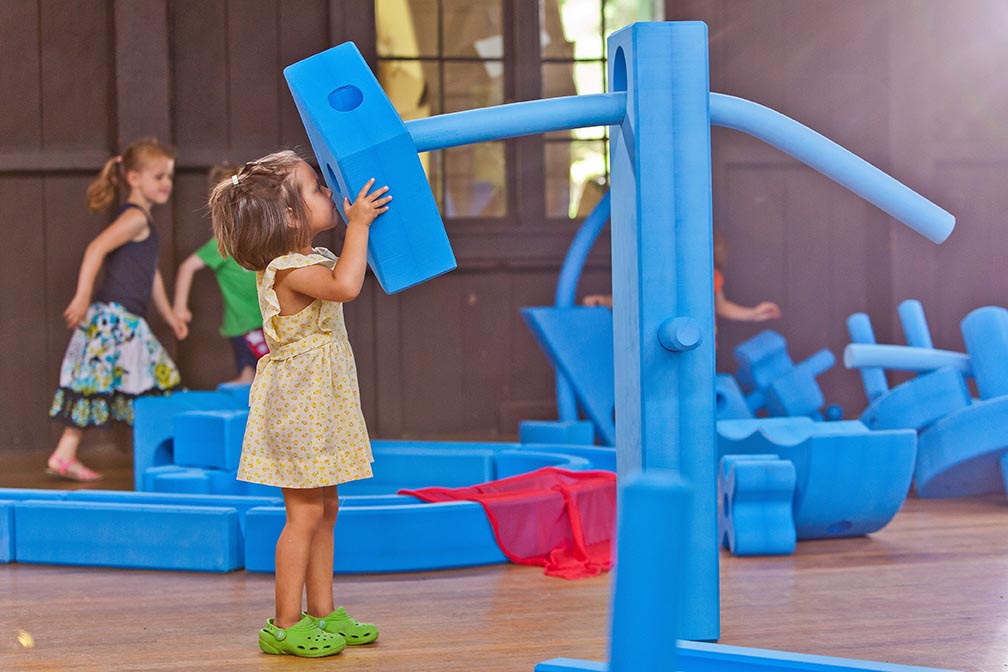
A collection of oversized foam blocks might become a castle one day, a pirate ship the next, and a bustling city the day after that. The possibilities are limited only by a child’s imagination.
Unlike toys or activities designed for a single purpose, open-ended play materials encourage children to think creatively, collaborate with others, experiment with ideas, and solve problems independently.
At Imagination Playground, we’ve seen firsthand how open-ended play transforms classrooms, museums, parks, libraries, and community spaces into environments where children naturally learn through exploration. Learn more about ourBig Blue Blocks and discover how they’re inspiring creativity around the world.

What Makes Play “Open-Ended”?
Open-ended play has several defining characteristics:
- There is no single correct outcome.
- Children determine how materials are used.
- Creativity is encouraged over instruction.
- Play evolves naturally over time.
- Children can play independently or collaboratively.
- The same materials can be used in countless different ways.
Rather than asking, “Did I do it correctly?” children ask:
- “What else can I build?”
- “How can we make this stronger?”
- “What happens if we try something different?”
- “Can we build it even bigger?”
These questions become opportunities for discovery.
Open-Ended Play vs. Structured Play
Both types of play have value, but they serve different purposes.
Structured Play
Structured play includes activities with defined rules or expected outcomes, such as:
- Board games
- Organized sports
- Following craft instructions
- Completing worksheets
- Building from instruction manuals
Children are learning, but they’re typically working toward a specific goal.
Open-Ended Play
Open-ended play encourages children to create the goal themselves.
Examples include:
- Building with large foam blocks
- Loose parts play
- Pretend play
- Nature exploration
- Inventing games
- Creating obstacle courses
- Designing imaginary cities
Instead of receiving answers, children create them.

Why Is Open-Ended Play Important?
Open-ended play supports nearly every area of childhood development simultaneously.
When children build, pretend, negotiate, test ideas, and collaborate, they’re developing skills that extend far beyond playtime.
Researchers and educators consistently recognize play as one of the most effective ways children learn because it integrates physical movement, social interaction, creativity, and critical thinking.
One preschool teacher shared how simply providing open-ended materials and stepping back allowed children to develop incredible ideas and stronger collaboration. Read Stepping Back and Watching Big Ideas Take Shape to see open-ended play in action.
Let’s look at the many developmental benefits.
1. Encourages Creativity and Imagination
Perhaps the greatest benefit of open-ended play is its ability to unlock imagination.
A curved foam block isn’t labeled as anything.
One child sees a race car.
Another sees a bridge.
Another imagines the tail of a dinosaur.
Every interpretation is correct.
Children become designers, storytellers, engineers, and artists all at once.
This type of creative thinking becomes increasingly valuable as children grow and face complex real-world challenges.
2. Builds Problem-Solving Skills
Every construction project presents challenges.
Questions naturally arise:
- Why did it fall over?
- How can we make it taller?
- Which block fits here?
- How do we connect these pieces?
Children experiment, observe results, adjust, and try again.
Instead of being given solutions, they discover solutions.
This process strengthens critical thinking while teaching persistence and resilience.
3. Develops Collaboration and Communication
Many of the most exciting creations happen when children work together.
Whether building a castle or creating a pretend town, children learn to:
- Share ideas
- Listen to others
- Negotiate
- Compromise
- Divide responsibilities
- Encourage teammates
These social interactions help develop communication skills that benefit children throughout school and life.
4. Supports STEM Learning
Open-ended play naturally introduces concepts found in science, technology, engineering, and mathematics.
Without realizing it, children explore:
- Balance
- Gravity
- Force
- Measurement
- Geometry
- Spatial reasoning
- Engineering
- Experimentation
For example, when children build a tall tower with Imagination Playground Big Blue Blocks, they’re learning about structural stability through experience rather than memorization.
5. Strengthens Fine and Gross Motor Skills
Building with large blocks involves movement.
Children lift, carry, stack, reach, bend, balance, and coordinate their bodies.
These activities strengthen:
- Core muscles
- Balance
- Coordination
- Hand-eye coordination
- Spatial awareness
Smaller components and accessories also encourage fine motor development.
The result is active learning that supports physical health while encouraging creativity.
6. Encourages Independent Thinking
Open-ended play gives children ownership.
Instead of waiting for instructions, they ask themselves:
“What should I build?”
This shift encourages initiative, confidence, decision-making, and independence.
Children begin trusting their own ideas instead of looking for approval.
7. Builds Confidence
Success during open-ended play isn’t measured by perfection.
Success comes from trying something new.
Each completed structure reinforces:
“I made this.”
Even when structures collapse, children learn that mistakes are simply opportunities to improve.
This mindset is beautifully illustrated in Stepping Back and Watching Big Ideas Take Shape, where children gained confidence simply by being given the freedom to explore.
8. Promotes Social-Emotional Development
Play provides opportunities to experience emotions in a safe environment.
Children practice:
- Empathy
- Patience
- Leadership
- Conflict resolution
- Cooperation
Pretend scenarios also help children process experiences and express feelings.
These emotional skills become the foundation for healthy relationships.
Open-ended play has also been shown to strengthen communities. Read How Open-Ended Play Helps Our Community Heal to learn how creative play brings people together.
9. Inspires Physical Activity
Unlike many passive activities, open-ended play keeps children moving.
They run.
They build.
They climb around structures.
They redesign spaces.
Movement and imagination work together, making active play enjoyable and engaging.
Many cities are embracing creative play spaces. Browse our Where in the World Are the Blue Blocks? series to see Imagination Playground installations across schools, museums, parks, and communities worldwide.
10. Keeps Children Engaged Longer
One reason educators love open-ended materials is their longevity.
A toy with one purpose often loses its appeal after children master it.
Open-ended materials remain exciting because every play session is different.
Today’s airplane becomes tomorrow’s submarine.
Children continue finding new ways to explore the same materials.
Examples of Open-Ended Play
Open-ended play can happen almost anywhere.
Examples include:
- Building with oversized foam blocks
- Loose parts play
- Cardboard construction
- Pretend grocery stores
- Puppet theaters
- Nature scavenger hunts
- Sand and water play
- Building forts
- Creating obstacle courses
- Designing miniature cities
The key is giving children materials that inspire creativity rather than dictate outcomes.

Why Imagination Playground Encourages Open-Ended Learning
Imagination Playground Big Blue Blocks were designed around one simple philosophy:
Children learn best when they lead the play.
Rather than telling children what to build, the uniquely shaped foam blocks encourage endless possibilities.
A single set can become:
- Castles
- Race tracks
- Robots
- Spaceships
- Bridges
- Animals
- Sculptures
- Entire imaginary worlds
This flexibility makes Imagination Playground ideal for schools, museums, libraries, parks, camps, and community events.
See how organizations around the world are using Imagination Playground:
- Explorium Denton Children’s Museum
- Westchase District in Houston, Texas
- MakeBelieve – The Baby Play Place in Edinburgh, Scotland
- Blue World (Plavi Svijet) in Croatia
Tips for Encouraging Open-Ended Play
- Choose versatile materials.
- Avoid giving too many instructions.
- Ask open-ended questions.
- Allow uninterrupted time for exploration.
- Celebrate the creative process rather than the finished product.
Frequently Asked Questions
What is the difference between open-ended and closed-ended play?
Open-ended play has no predetermined outcome, while closed-ended play typically has one correct way to complete an activity or use a toy.
Is open-ended play good for classrooms?
Yes. It supports creativity, collaboration, STEM learning, communication, social-emotional development, and problem-solving, making it valuable across virtually every learning environment.
Can open-ended play support STEM education?
Absolutely. Building, experimenting, designing, and testing naturally introduce engineering, math, and scientific thinking through hands-on exploration.
Final Thoughts
Open-ended play is far more than entertainment—it’s one of the most effective ways children develop creativity, confidence, communication, resilience, and critical thinking.
When children are free to imagine, experiment, and collaborate, they build much more than towers or castles. They build the skills they’ll use throughout their lives.
Whether in a classroom, museum, park, library, or community event, providing opportunities for open-ended play creates environments where curiosity thrives and every child has the freedom to become an inventor, engineer, storyteller, or explorer.
If you’re looking for even more inspiration, explore our Big Blue Block Blog to discover real-world success stories from educators, museums, parks, and communities using Imagination Playground every day.